By Qomvia, 14 min read
Key takeaways
ChatGPT states something wrong about your company, and customers read it as fact. AI assistants now answer the question before anyone clicks a result, so a wrong answer can cost you deals you never hear about.
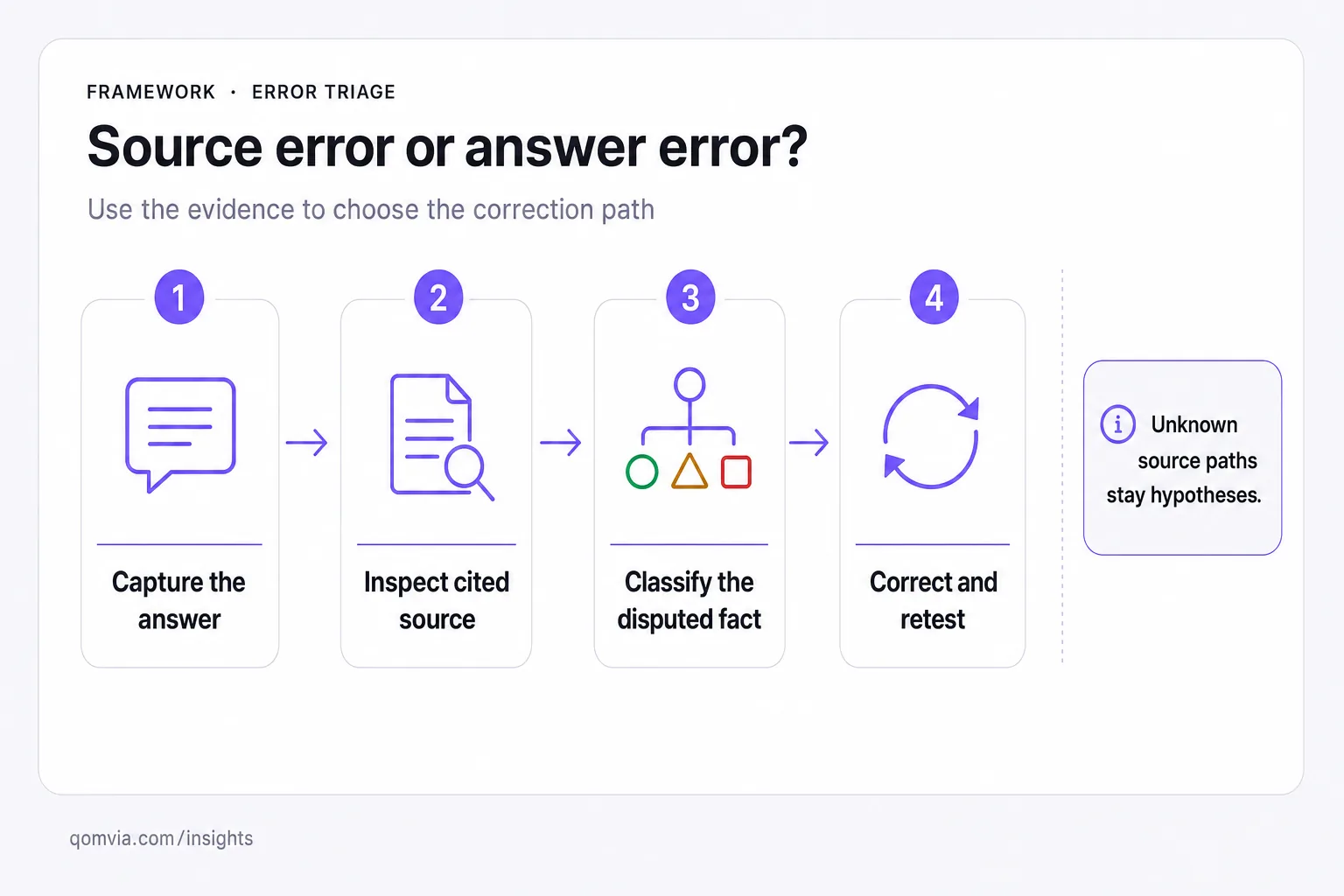
- Capture the exact error: save the prompt, response, cited sources, product surface and date before changing anything.
- Separate source error from model error: the cited page may be wrong, or the answer may distort an accurate source.
- Correct the authoritative record first: update the owned page or public profile that controls the underlying fact.
- Use available feedback controls: report a specific error with evidence, without assuming an immediate model update.
- Retest the same question: compare saved answers over time and keep the original conditions visible.
What should I do about wrong AI answers about my company?
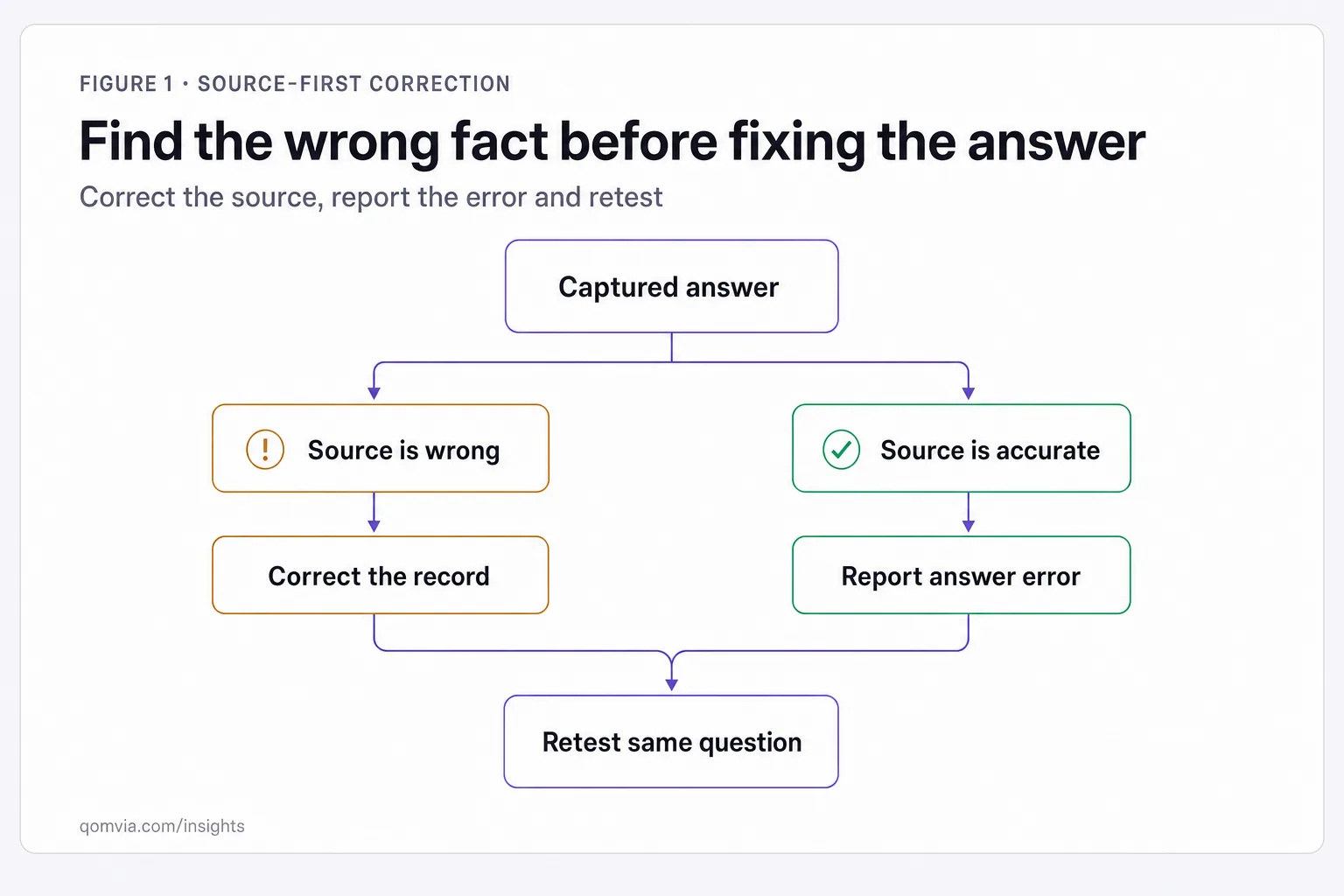
When an AI answer says something wrong about your company, preserve the exact response and trace each disputed statement to its source. Correct the authoritative page or profile if it is wrong, use any available product feedback route and monitor the same question later. This process addresses evidence and provenance without promising a particular model change.
The urgency depends on the claim. A wrong phone number can send customers to the wrong place; a false safety, pricing or policy statement can create greater harm. Prioritize errors by their likely impact and correct the source that customers and systems are most likely to consult. Do not begin by publishing a rushed rebuttal that repeats the error without context.
Use a source-first diagnostic. Determine whether the underlying record is inaccurate, outdated or ambiguous, then check whether the answer quotes or paraphrases it correctly. The correction path differs for each case. For persistent naming and profile inconsistencies, see entity SEO; for competitor and preference problems, read why ChatGPT recommends your competitor.
How should a team capture the error?
Save a reproducible observation
Save the complete answer, not only a cropped sentence. Record the exact question, the product and mode, the date, the language or market context and any visible source links. If the response was generated from a shared link or uploaded file, note that context. A later reviewer needs enough information to reproduce the observation as closely as possible.
Quote the disputed passage and state what is wrong in a short, testable way. “It gets us wrong” is not actionable. “The response says the service is available in Region A, but the current policy page excludes Region A” gives a reviewer a fact to verify. Attach the official page, effective date and owner of the correction.
Keep separate records for each distinct claim. One answer may contain an outdated name, an incorrect product relationship and a fabricated policy. Each can have a different cause and source. A clear issue log tracks the claim, evidence, severity, correction owner, feedback status and retest result without reducing the case to a single sentiment label.
Capture the observation in a controlled record rather than spreading screenshots through chat. Include the collection context, who reported it, the affected audience and whether the answer could change a purchase or safety decision. Restrict access when the capture contains personal information or account details. A concise incident record makes the case easier to review while reducing unnecessary exposure.
Separate the exact claim from its interpretation. “The company is not available in Region A” is a factual assertion that can be checked against a policy. “The company is unreliable” is an evaluative statement that may reflect a source's opinion. Record the wording before deciding whether it is wrong, incomplete, outdated or simply unfavorable. That classification determines whether a factual correction is appropriate.
| Record | What to preserve | Why it matters |
|---|---|---|
| Question context | Exact prompt and product mode | Supports a comparable retest |
| Answer evidence | Full response and cited URLs | Separates source wording from model summary |
| Disputed fact | Exact claim and authoritative record | Makes the correction verifiable |
| Resolution | Source update, feedback and retest | Shows which actions occurred |
Is the source wrong, or is the answer wrong?
Trace claims back to a source
Open every cited page and locate the passage that could support the response. The source may contain an old policy, a stale profile or language that can be read two ways. If so, repair the source and its internal references. If the answer attributes a claim the source does not make, the issue may be in the answer's extraction or synthesis rather than the page itself.
Look for contradictory first-party facts. A product page may describe one availability rule while a help article preserves an older version. A profile may use a former company name. A partner directory may identify a reseller as the manufacturer. Resolve the conflict at its source and explain historical context when an older statement remains legitimately available.
If there is no visible citation, do not assume the model relied on the page you found through a general search. Record the lack of attribution as an unknown path. Search your own public materials and canonical profiles for the disputed wording, but label a suspected source as a hypothesis until there is evidence. A confident attribution without a source can send the team toward the wrong fix.
Compare the answer with the source as it existed when the response was captured if that version is available. A page may have changed after the answer was produced, or an archived profile may contain the old fact. Keep the current page and any trustworthy historical copy separate. This helps the team distinguish a stale answer from a page that was already corrected before the sample.
Check whether the answer combined multiple claims. It may accurately quote one source but attach a detail from another, or omit the condition that makes the original statement true. Mark each disputed clause and identify whether its source is known. A response-level label such as “wrong” is too coarse to guide an editor when some parts are correct and others are not.
How do I correct an outdated company fact?
Check every source the company controls before filing a report elsewhere. A current homepage alongside an old policy page or product feed creates conflicting evidence. Correct the authoritative source, remove or redirect obsolete material where appropriate and keep an internal record of the replacement. Then identify which external page, if any, still repeats the outdated fact.
Choose a canonical source for the fact and give it a clear owner. For a policy, publish the current rule and its effective date. For an organization name, state the official name and any transition from a former one. For a product, identify who makes or sells it and which version is current. Then update pages and profiles that the organization directly controls.
Avoid leaving the correction only in a press release or social post. The page that answers the original customer question should contain the current fact. Add internal links from older material when it remains useful, and mark archived policy or product pages so their status is obvious. If a record must remain for compliance, explain that it is historical rather than silently deleting context.
When a third-party profile is wrong, use its established correction or ownership process and provide evidence appropriate to the claim. Do not create an unofficial duplicate that makes the identity less clear. Keep a copy of the request and the response. After a correction, compare later answers with the updated source and report the observed timing rather than promising immediate use.
Prioritize source corrections by authority and downstream use. Update the page that customers should rely on, then review related product, support and policy pages for the same stale statement. If a source must remain online for legal or historical reasons, label its status and link to the current rule. Do not erase a historical record in a way that makes a past transaction impossible to understand.
Give every correction an owner and a proof of completion. A ticket can record the previous wording, the approved replacement, the canonical destination and the date the public page changed. Verify the live page after deployment and preserve a snapshot where policy allows. This confirms that the source is fixed before the team evaluates whether a later answer reflects it.
How should a team use feedback and reporting controls?
Use the product's reporting channel for a specific factual error when one is available, and include the response or source needed to evaluate the report. Save a copy of what was submitted and when. A feedback action documents the company's request; the provider controls whether and when it acts, so record any acknowledgement and compare later answers.
Use a product's available feedback or reporting control when it supports a specific correction. Keep the report concise: quote the incorrect statement, identify the correct fact, provide the authoritative source and explain why the difference matters. Do not send a broad complaint with no reproducible prompt or evidence.
Use feedback as a request for review. Provider documentation may not disclose whether a particular answer was changed or how the report affects future responses. Preserve the submission date and any acknowledgement, then tell customers what the record shows without assigning an unverified schedule.
If an answer exposes personal or sensitive information, follow the provider's relevant privacy or safety reporting process in addition to correcting the public source. Limit internal access to sensitive captures and follow retention policies. Do not circulate screenshots more widely than necessary to resolve the issue.
Assign feedback work to someone who can submit a precise report and track its status. Keep the report separate from internal source remediation: one action changes a public record, while another asks the product provider to review an answer. If either path is unavailable, record that limitation rather than implying the team has completed both steps.
Avoid sending repeated feedback for the same response without new evidence. Preserve the original submission and any provider acknowledgement, then follow the stated channel for additional material if the issue persists. A report is not a mechanism for controlling all future outputs, so communicate the operational status without promising the wording will change.
How can the team verify that the answer improved?
Retest the same query and surface that produced the original observation, then preserve the new response beside the earlier one. Note whether the system, wording or visible source links changed. A corrected answer on one run documents that sample; continue testing because later responses can vary by user and context.
Check the correction against the facts the company owns. If the response now cites a source, open it and verify that the relevant claim is actually supported. If no link appears, compare the answer with the canonical page and keep the attribution status unknown. A statement can happen to be correct while still relying on a source the team has not identified.
Separate a factual correction from a preference request. A company can ask a publisher or platform to correct a demonstrable error, but it cannot require an independent service to recommend its product or adopt its preferred description. Use a calm, specific report with the exact claim, evidence and correction needed rather than a broad demand to remove unfavorable context.
Set a review window based on the channel changed. A page owner can verify a live page directly after publication; an external profile may have its own review process; an answer sample needs a later observation. Record when the team checked and what remained unresolved. Avoid promising a correction date when the company does not control the publisher or model.
Close the issue only when the source of the mistake has been addressed or the remaining limitation is clearly recorded. A temporary answer change does not resolve a stale source that can recur. Conversely, a corrected canonical source may be a completed company action even if an assistant's next response is outside the team's control.
Retest the original question under the same product mode and context after the source correction. Save the new full answer and compare the disputed claim, source links and organization identity. If the product or prompt changes, record the difference rather than treating it as a direct before-and-after comparison.
Use more than one related question when the issue affects a broader fact, but keep each question's result separate. Ask whether the product now states the correct fact, whether it cites the corrected source and whether the answer has retained important conditions. A single improved response does not prove that every user will receive the same version.
Keep the outcome categories simple: source corrected, external profile request submitted, feedback sent, error absent in retest, error remains or result inconclusive. This gives stakeholders an honest operational status. For definitions of answer samples and source citations, read AI search visibility measurement.
Use the same task wording, product mode and relevant context for the first retest, then run related questions only when they test a distinct aspect of the fact. Record any changed product surface or source link. Compare the disputed claim itself, not just whether the company appeared. An answer that now names the brand but repeats the error has not resolved the incident.
Set an explicit closure rule. The source can be corrected even if the sampled answer remains unchanged; the feedback request can be closed as submitted even if the provider gives no outcome; the factual issue can remain open if the public record is still contradictory. Separate these workstreams so the team can report completed actions and unresolved behavior accurately.
Review whether the error recurs across the company's own channels. If the correct fact is now consistent but one sampled answer still differs, preserve that distinction for future reviews. If multiple public pages continue to conflict, return to the source inventory rather than escalating the answer report. The best retest plan depends on which part of the evidence chain remains uncertain.
What should a brand do first?
Assign one incident owner who can coordinate evidence, page changes and follow-up without overstating the company's control. The owner should record the original response, route the issue to the source owner and identify who will review the next sample. For high-impact errors, involve legal, communications or customer support under the organization's existing escalation rules.
Write a correction that is easy for an outside reviewer to evaluate: identify the exact claim, give the authoritative source and explain the requested factual change. Avoid sending several competing descriptions from different company teams. One consistent, documented correction is easier to assess than a broad message that asks an independent service to prefer the brand.
Create an incident record, find the authoritative fact and assign a correction owner. Prioritize errors that could change a customer decision or cause harm. Fix the public source before issuing a broad statement, then use any relevant feedback channel and retest the original question. Preserve uncertainty where the source path cannot be verified.
This sequence avoids two common mistakes: blaming a model when the company's own pages conflict, and changing a source that was already correct because an answer paraphrased it badly. A disciplined correction strengthens the public record whether or not the next sampled answer changes immediately.
How Qomvia helps you catch and fix wrong answers
Qomvia's AI monitor asks the same questions daily, so a wrong claim shows up quickly, and the free score shows which identity signals on your site need fixing.
The free scan runs all 26 checks of the agent-readiness score in about a minute and lists every failing check with a copy-paste fix; the free Site monitor re-scans weekly, no signup for the score. The AI monitor then asks your buyers' questions to ChatGPT, Gemini and Grok every day and shows whether you are named, which rival is named instead and which sources the models used. Qomvia Market and the MCP server take it one step further, letting agents act on the recommendation. Sign up free or see plans and pricing.
Sources and further reading
Questions
- How do I fix wrong information about my company in ChatGPT?
- Save the exact answer, inspect its sources, correct any inaccurate authoritative page, use an available feedback route and retest the same question.
- How can I tell whether the source or the AI answer is wrong?
- Compare the answer with the cited passage and your canonical fact. If the source is stale or ambiguous, correct it; if the source is accurate, record a possible answer synthesis error.
- Will reporting a wrong AI answer update the model?
- A feedback report is a request for review, not an editing control. Save its status and monitor later answers without assigning an unverified update schedule.
- What evidence should I include in an AI answer correction?
- Provide the exact prompt and statement, the correct fact, a current authoritative source and context such as an effective date when it matters.
- How do I monitor whether an AI answer was corrected?
- Retest the same question with the same product mode and context, preserve the new answer and compare the disputed fact and source links.
- What should I do about outdated brand profiles?
- Correct the owned source first, then use the profile's established process with supporting evidence. Keep the request status visible and do not create confusing duplicates.
Score your own site against the rubric this is written from.
Is your site agent-ready?
Free score against the same rubric, in under a minute.
Sign up free to keep the fixes and track the score.
AI monitor
PreviewHow often each model names your site across 11 tracked questions.